Difference between revisions of "2012 Summer Project Week:VertebraCTUSReg"
| Line 7: | Line 7: | ||
==Key Investigators== | ==Key Investigators== | ||
| − | * | + | * University of British Columbia, Robotics & Control Laboratory |
| − | * | + | * Queen's University |
<div style="margin: 20px;"> | <div style="margin: 20px;"> | ||
| Line 14: | Line 14: | ||
<h3>Objective</h3> | <h3>Objective</h3> | ||
| − | We are developing | + | We are developing a new module as a puzzle block for a spine injection image-guided intervention.<br /> |
| + | The ultimate goal is to plan for injection based on prior CT-image and perform the treatment using ultrasound-based needle guidance. | ||
| + | A volumetric representation of the patient's lumbar section is being reconstructed using tracked frames. | ||
| + | This volume should go through a registration algorithm to rigidly align with the model generated from CT image. | ||
| Line 26: | Line 29: | ||
<h3>Approach, Plan</h3> | <h3>Approach, Plan</h3> | ||
| − | + | A bone probability volume is generated from the original ultrasound volume. | |
| − | + | From the CT image, a subset of visible points is extracted. | |
| − | + | A guassian mixture model method is performed to solve for this surface to volume registration problem. | |
| − | |||
</div> | </div> | ||
| Line 36: | Line 38: | ||
<h3>Progress</h3> | <h3>Progress</h3> | ||
| − | + | All implementations are based on a single vertebra registration for now. | |
| + | A loadable module is created which accepts a CT model (polydata) and an ultrasound volume (scalar) as inputs. | ||
| + | All inputs need to be limited to region of interest (i.e. a single vertebra: L3). | ||
| + | Core implementation of the algorithm is MATLAB-based, since the algorithm is quite fast and speed is not an issue. | ||
| + | A gaussian mixture model is used to register surface to volume. output of the module is the rigid transformation matrix obtained in this way. | ||
| + | A spine phantom data is used for validation. Patient recruitment is an ongoing task for this project. | ||
Revision as of 03:22, 8 June 2012
Home < 2012 Summer Project Week:VertebraCTUSReg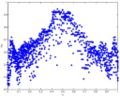
Scatter plot of the original FA data through the genu of the corpus callosum of a normal brain.
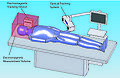
Regression of FA data; solid line represents the mean and dotted lines the standard deviation.


Key Investigators
- University of British Columbia, Robotics & Control Laboratory
- Queen's University
Objective
We are developing a new module as a puzzle block for a spine injection image-guided intervention.
The ultimate goal is to plan for injection based on prior CT-image and perform the treatment using ultrasound-based needle guidance.
A volumetric representation of the patient's lumbar section is being reconstructed using tracked frames.
This volume should go through a registration algorithm to rigidly align with the model generated from CT image.
Approach, Plan
A bone probability volume is generated from the original ultrasound volume. From the CT image, a subset of visible points is extracted. A guassian mixture model method is performed to solve for this surface to volume registration problem.
Progress
All implementations are based on a single vertebra registration for now. A loadable module is created which accepts a CT model (polydata) and an ultrasound volume (scalar) as inputs. All inputs need to be limited to region of interest (i.e. a single vertebra: L3). Core implementation of the algorithm is MATLAB-based, since the algorithm is quite fast and speed is not an issue. A gaussian mixture model is used to register surface to volume. output of the module is the rigid transformation matrix obtained in this way. A spine phantom data is used for validation. Patient recruitment is an ongoing task for this project.
Delivery Mechanism
This work will be delivered to the NA-MIC Kit as a (please select the appropriate options by noting YES against them below)
- ITK Module
- Slicer Module
- Built-in
- Extension -- commandline
- Extension -- loadable
- Other (Please specify)
References
- Fletcher P, Tao R, Jeong W, Whitaker R. A volumetric approach to quantifying region-to-region white matter connectivity in diffusion tensor MRI. Inf Process Med Imaging. 2007;20:346-358. PMID: 17633712.
- Corouge I, Fletcher P, Joshi S, Gouttard S, Gerig G. Fiber tract-oriented statistics for quantitative diffusion tensor MRI analysis. Med Image Anal. 2006 Oct;10(5):786-98. PMID: 16926104.
- Corouge I, Fletcher P, Joshi S, Gilmore J, Gerig G. Fiber tract-oriented statistics for quantitative diffusion tensor MRI analysis. Int Conf Med Image Comput Comput Assist Interv. 2005;8(Pt 1):131-9. PMID: 16685838.
- Goodlett C, Corouge I, Jomier M, Gerig G, A Quantitative DTI Fiber Tract Analysis Suite, The Insight Journal, vol. ISC/NAMIC/ MICCAI Workshop on Open-Source Software, 2005, Online publication: http://hdl.handle.net/1926/39 .

